Getting off VMware shouldn't require buying a new cluster.
Almost every VMware exit plan starts with a hardware quote. That turns a licensing problem into a capital project, a procurement cycle, and a rack you have to run for five years. HVENS is the other option: a US private cloud that takes your existing workloads as a monthly service. Same VMs, same applications, no purchase order.
The renewal is the trigger. The hardware quote is the trap.
Since Broadcom closed on VMware, renewals arrive with bundled SKUs you didn't ask for, subscription-only terms where perpetual licenses used to be, and core-based counting instead of sockets, with a 16-core floor per CPU and quotes often shaped by a much larger order minimum. For a lot of mid-market shops the number is no longer defensible to a CFO.
Why the obvious response is the wrong one
The usual next step is to price out a replacement cluster and migrate to a different hypervisor on your own iron. That works, and we do those projects. But it answers an operating-expense problem with a capital purchase, and it leaves you owning hardware, spares, firmware, and a refresh cycle you didn't have to take on.
You were already renting
If your VMware estate ran on a subscription, you were paying monthly for a platform someone else developed. Moving to a hosted private cloud keeps that shape. What changes is who you write the check to and what it buys.
No procurement cycle
No hardware quote, no lead times, no board approval for a capital line item. Compute, storage, and bandwidth are monthly and sized to what you actually run. Grow or shrink the pools as the estate changes.
Your renewal clock is the deadline
The useful thing about a renewal date is that it's fixed and known. Tell us when yours lands and we'll work backwards from it. Staged migrations mean you don't need everything moved to stop paying for the next term.
What actually changes, and what doesn't
The question in every VMware migration conversation is whether something inside the VMs breaks. In practice your workloads come across intact. The hypervisor underneath them changes from vSphere to Proxmox VE; the operating systems and applications inside them carry on exactly as they are.
- Keeps working as-is. Windows Server, Active Directory domain controllers, RDS and session hosts, file and print, SQL Server, Linux of whatever distribution, and the line-of-business applications your users actually open.
- Changes underneath. The hypervisor, the storage backend, and the management console. Your VMs get VirtIO drivers and new network parameters as part of the move, which is our work to do, not yours.
- Changes on the invoice. One monthly bill covering compute, storage, bandwidth, and support instead of a licensing renewal plus hardware depreciation plus a maintenance contract.
- Changes for the better. No egress metering, no per-second billing math, no reserved-instance puzzles to solve before you can forecast next quarter.
Buy capacity, then run whatever you want in it.
We sell compute and storage as pools rather than pricing individual VMs. You buy vCPU, RAM, and block storage in the tier that fits the workload, then build and resize VMs inside that pool without renegotiating anything. There is no instance-type catalog to translate your existing VM sizes into, which removes most of the sizing busywork from a migration.
Three performance tiers
Bronze, Silver, and Gold differ in hardware generation and performance headroom, with contention falling as the tier rises. Put the domain controllers and batch jobs on a lower tier and the SQL box on Gold.
Chosen independently
Compute tier and storage tier are chosen independently, so storage-heavy workloads aren't forced onto expensive compute.
Storage that matches the workload
ZFS on spinning disk for bulk and archival, Blockbridge NVMe for latency-sensitive databases.
How it behaves
Block volumes behave like physical disks - you format, partition, and manage them at the OS level, exactly as you do today.
Bring your firewall or use ours
Dedicated internet access if you want to keep your own firewall at the edge with a routed block behind it, or our managed OpenBSD gateway if you'd rather we own NAT, packet filtering, and site-to-site IPsec.
Either way
Both are options, not a default we impose.
Private layer 2 handoff
If you're already in a colo or on a carrier we can meet, a cross-connect gives you a private layer 2 path into your environment without traversing the public internet.
When it matters
Useful when the migration is a hybrid that has to stay hybrid.
Microsoft licensing included if you want it
Windows Server, RDS CALs, and SQL Server can be licensed monthly per VM through us under SPLA, so you don't need your own Microsoft agreement.
Or bring your own
Bring your own licenses instead if that's cheaper for you - both are supported.
Tenant isolation on EVPN
Tenant segmentation is done on an EVPN fabric rather than stretched VLANs, with east-west traffic between your own VMs unmetered.
Capacity
Network capacity across the platform runs from 50 Mbps to 100 Gbps.
Backups are part of the platform, not an upsell.
Workloads running in HVENS are protected by Proxmox Backup Server, and those backups replicate to the paired region. Backup is on by default and billed per GB of backup data, which gets you an offsite copy of every protected VM disk without designing anything or funding a second facility. From there you choose how fast you need to be running again, per workload rather than for the whole estate.
Cold DR, which you get by default
Once a VM is backed up, its data lives in the second region. If the primary facility has an outage, every protected disk is safe and recoverable - no second site to fund and nothing extra to design. When a workload also needs a committed recovery time, Warm DR is the step up.
Warm DR, when a workload has to come back fast
Reserve compute, RAM, and block storage in the DR region at half the primary rate, and we build a written recovery runbook with you. The planning work is part of that price, not a separate professional-services line. Choose it per pool, so only the workloads that genuinely can't wait carry the cost.
We can be your DR target while you still run VMware
You don't have to move production to get value here. We act as an offsite Proxmox Backup Server target for on-prem environments, and in a disaster recovery scenario we can restore VMs from Veeam for customers still running VMware on-site. Plenty of customers start here, prove the recovery path, and move production later.
Your copy of the backups, if you want it
We can replicate backups of your cloud VMs back to hardware you own, so the offsite copy isn't entirely on our infrastructure - useful when a contract or an auditor wants a copy under your control. It restores through Proxmox Backup Server on your side, which we'll help you stand up.
S3-compatible target for Veeam
Veeam can write straight to an S3-compatible target here, so Veeam backups store and restore in our cloud for DR without changing the backup product you already run. The backend is new enough that we size and onboard it with you rather than handing over a bucket and a URL, so get in touch and we'll set it up together.
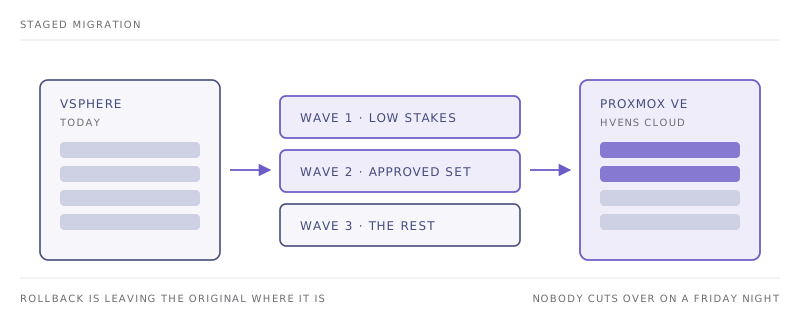
You keep running VMware until you don't need to, which means the rollback plan at every stage is leave it where it is.
Why a staged migration is the low-risk oneMigrations happen in waves. Nobody cuts over on a Friday night.
We stand up your environment alongside the VMware estate you're still running, move workloads in groups, validate each group, and decommission the old side once you're satisfied. Networking and storage take the most planning; the VMs themselves are usually the easy part.
- Inventory and design. We look at what you're running - VM count and sizes, storage footprint, network topology, licensing, and what your renewal date is. You get a proposed target design and a wave plan.
- Environment build. Your pools, network, gateway or DIA, and backup configuration get built and handed to you to look at before a single production VM moves.
- Migration in waves. Low-risk workloads first to prove the path, then the rest in groups you approve. Each wave is validated before the next one starts.
- Cutover and decommission. DNS and IP changes are planned in advance, not improvised. Once you're satisfied, the VMware side goes away and so does the renewal.
Scope and effort depend on the size and shape of the estate, so the migration work is quoted per engagement once we've walked the inventory with you. That first conversation costs nothing, and you come out of it with a target design and a number to compare against your renewal.
You're leaving VMware because ownership changed. Ask who owns us.
The reason your renewal got worse is that the company behind your platform was acquired and repriced. That's worth keeping in mind while you choose the next one. Richweb is family and employee owned - no private equity, no exit thesis, no acquisition that reprices you in three years. We've run infrastructure for other businesses since 1995 and we operate the HVENS platform ourselves.
You reach engineers
Your escalation path is the team that operates the hypervisors and the network, not a tier-one script reader who has to file a ticket to reach someone who can change something. We've carried customers for ten, fifteen, twenty years because that matters more than any datasheet.
We run the platform we sell
HVENS runs on Proxmox VE in production, and Richweb is a Silver-level Proxmox Partner with direct escalation into Proxmox engineering. The engineers who handle your migration are the same ones running the platform every day.
Audited and US-based
SOC 2 Type II, which your procurement team will ask about. Two carrier-neutral mid-Atlantic facilities - Ashland, Virginia and Denton, Maryland, roughly 150 miles apart on separate power grids and separate fiber paths. Data stays in the United States.
Moving clients off VMware, not just yourself?
If you're an MSP or ISP with a book of clients facing the same renewal, there's a reseller program behind this. Tiered discounts on cloud pricing, white-label available, consolidated monthly billing, and a customer console you can put your own brand on so your clients see you rather than us.
Would rather own the hardware?
Some environments are a better fit on-prem, and we'll say so if yours is one of them. Richweb runs VMware-to-Proxmox migrations on customer hardware, per-asset managed Proxmox contracts, and the HVENS Vault backup appliance line as a separate practice.
Common questions
What comes up on nearly every renewal call. Open any of them.
Do I have to buy hardware to get off VMware?
No. Most VMware exit advice assumes you stand up a replacement cluster on your own hardware, which turns a licensing problem into a capital purchase. HVENS is hosted, so your workloads land on our infrastructure and you pay monthly. If you'd rather own the hardware, we do that too as a separate practice.
Will my existing VMs run on HVENS?
Yes. Windows Server, Linux, SQL Server, RDS session hosts, domain controllers, and line-of-business applications all run the same way after the move. The hypervisor underneath changes from vSphere to Proxmox VE; what's inside your VMs doesn't.
What happens to my Windows and SQL licensing?
Bring your own licenses, or license Windows Server, RDS CALs, and SQL Server monthly per VM through us under SPLA - no Microsoft agreement of your own required. Monthly SPLA licensing is valid while the workload runs on HVENS.
Can you be a DR target while I still run VMware?
Yes, and it's a common first step. We act as an offsite Proxmox Backup Server target for on-prem environments, and in a DR scenario we can restore VMs from Veeam for customers still running VMware on-site. Veeam can also write straight to an S3-compatible target here.
Do you charge egress fees?
No. Bandwidth is a committed monthly rate rather than metered per gigabyte, so your invoice doesn't move because of how much data your applications served this month.
How is this priced?
Compute, RAM, and storage are sold as monthly pools by tier, with bandwidth and any licensing on top. It's flat and month-to-month rather than consumption-metered. Tell us what you're running and we'll come back with a quote, typically within a day.
Where does my data live?
Ashland, Virginia is the primary region and Denton, Maryland is the paired DR region, about 150 miles east on a separate power grid and separate fiber path. Both are carrier-neutral. Everything stays in the United States.
What if we only want to move part of the estate?
That's normal and it's supported. Private layer 2 handoff or site-to-site IPsec keeps a hybrid environment working, and plenty of customers land backup and DR with us first while production stays where it is.