Four options. Here's where each one wins.
Most vendor comparison pages are written so the vendor wins every row. This one isn't, because you are going to check it. If you run somewhere between ten and fifty virtual machines, you are really choosing between hyperscale cloud, a developer cloud, buying your own cluster, and renting a private one. Three of those are sometimes the right answer, and we say which three and when.

Each option gives you two of the four things you need.
A business running a domain controller, a file server, a session host, a database, and the software your staff open every morning needs four things at once: something simple enough to operate without a dedicated cloud team, something that genuinely runs Windows and line-of-business workloads, something that does not require a capital purchase, and someone competent to call. The market is set up so that you can have two.
Hyperscalers do everything except simple
AWS and Azure will absolutely run your workloads. An EC2 or Azure VM is a perfectly good place to put a Windows server, in more regions than you will ever need, with managed services attached to them. The cost is a surface area nobody at a forty-person company has time to learn, a bill whose shape depends on decisions you did not know you were making, and support that is a paid tier rather than a phone number.
Developer clouds are simple because they do less
DigitalOcean, Hetzner, Vultr, and Linode are a pleasure to use and their pricing is genuinely easy to predict. They are also built for developers deploying Linux applications. Windows Server, Active Directory, RDS licensing, and an engineer who knows your environment are not what they sell, and a prospect told "just use DigitalOcean" for an AD estate has been mis-served.
Owning is familiar, and indivisible
Buying is the option most small businesses know how to evaluate, which is part of why it wins by default. The difficulty is that redundancy does not scale down: three hosts, redundant shared storage, a second site, and a tested restore cost roughly the same whether twenty workloads or two hundred sit on top of them.
The comparison, including the rows we lose.
Read across a row rather than down a column. The last row is the one that matters most, because it is the one that tells you whether to keep reading or go somewhere else.
Scroll the table sideways to see all four options.
| Hyperscale cloudAWS, Azure, Google Cloud | Developer cloudDigitalOcean, Hetzner, Vultr, Linode | Your own clusterHardware you buy and house | HVENSHosted private cloud | |
|---|---|---|---|---|
| Windows Server, AD, RDS, SQL | Fully supported | Varies, and mostly not their market. DigitalOcean does not offer Windows at all, Akamai Cloud (Linode) is Linux only, and Hetzner Cloud is bring-your-own-licence with no Windows support. Vultr does licence Windows per instance. SQL Server and RDS CALs are your own licences everywhere in this column | Fully supported, with your own licensing agreement | Fully supported. Bring your own licences or take Windows, RDS CALs and SQL monthly per VM under SPLA |
| What you have to learn | Hundreds of services, IAM, and a networking model that is its own discipline | Very little. This is their real strength | Nothing new, you already run it | Proxmox VE. Virtual machines and capacity pools, not an instance-type catalog |
| Who picks up when something breaks | A support plan you buy separately. At AWS and Google it is priced against what you spend; Azure's tiers are a flat monthly fee | A ticket queue | You, or whoever you retain | The engineers who operate the platform, not a first-line script reader. Business hours, with monitoring and escalation outside them |
| Outbound bandwidth | Metered. Roughly $0.09/GB for the first 10 TB at US list rates, after 100 GB free | Pooled monthly allowance, overage roughly $0.005 to $0.01/GB and cheaper still at Hetzner. Predictable | Your own circuit, flat, but you buy two if you want it redundant | Committed monthly rate, not metered. No charge between your own VMs |
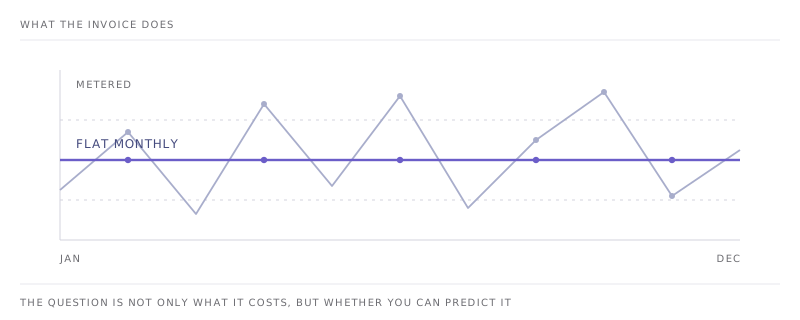
| Shape of the bill | Varies with usage, and rewards ongoing optimization work | Mostly flat, with overage possible | Large capital event, then flat, then another capital event | Predictable billing by design: flat monthly per pool, month to month, no minimum term to start |
| Up-front capital | None | None | The whole cluster, plus storage, switching, UPS, and cooling | None |
| Second site for DR | Available anywhere, but you design it, run it, and pay for both sides | Mostly do-it-yourself, with fewer building blocks | A second building you fund, connect, and staff | Paired region 150 miles away on a separate grid and fiber path. Warm DR at half the primary rate, chosen per workload |
| Offsite backup | Configured and billed separately, including its own egress | Do-it-yourself | A backup server, plus somewhere else to send it | Proxmox Backup Server replicating to the second region. On by default, billed per GB of backup data, with the offsite copy part of it rather than a separate product |
| Hardware refresh in year five | Not your problem | Not your problem | A new capital request, and the whole conversation restarts | Not your problem. The generation underneath you is ours to keep current |
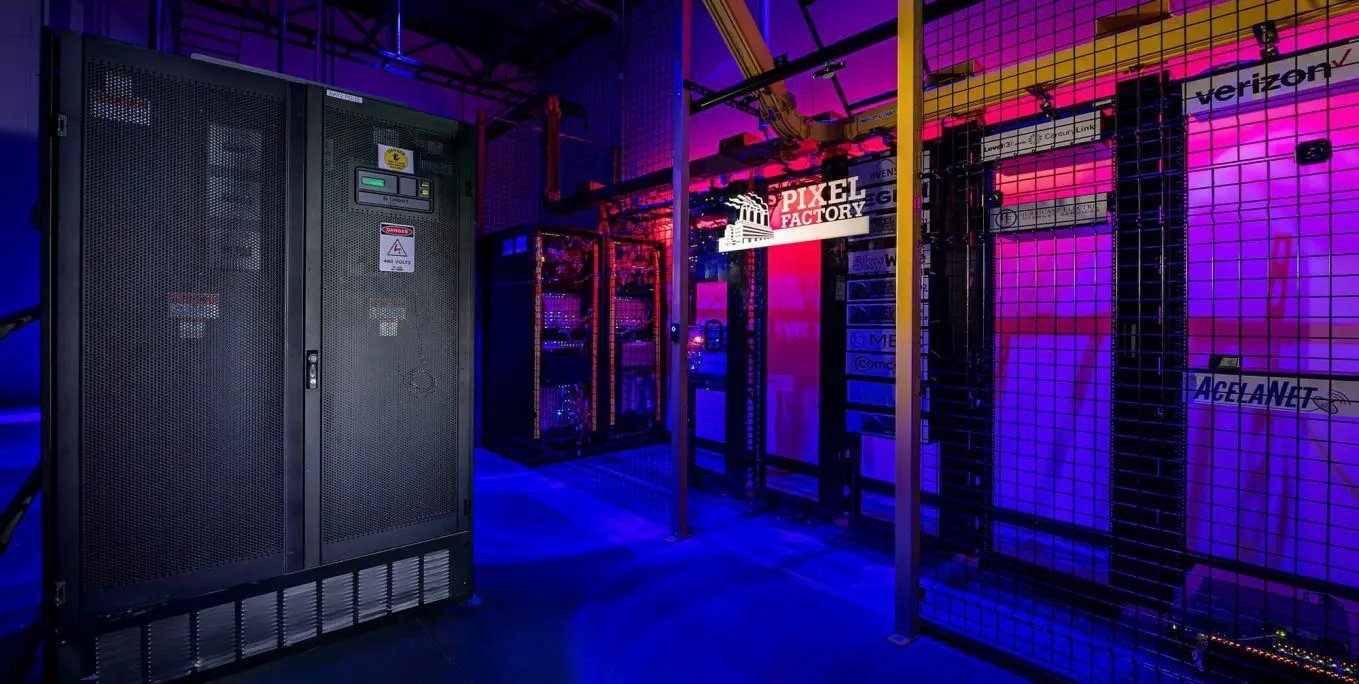
| Where the data sits | Your choice of region, operated by a global provider | Varies by provider, often offshore | Your building, which is also its single point of failure | Ashland, Virginia and Denton, Maryland. US only, SOC 2 Type II, carrier-neutral |
| Elastic burst and managed services | The reason to choose them. Nothing here competes | Some, aimed at application developers | None. You sized it once | Resize pools when you need to, but this is not spot-priced elastic scale and we will not pretend it is |
| Getting in, and back out again | Lifting a Windows estate in often means re-architecting parts of it, and managed services and provider-specific networking have to be unwound to leave | Simple in and out for a Linux application, less so once you have adopted their managed pieces | Nothing to join or leave, which is the appeal. The move is buying and racking it | VMs arrive as they are and leave the same way. Standard Proxmox VE and standard virtual disks, portable to another provider or back on-premise |
| Choose this when | You need global scale, managed data services, or genuinely spiky demand | You are shipping a Linux application and want the least complexity possible | Load is steady, you have staff and space, and roughly 50+ VMs to amortize across | 10 to 50 VMs, Windows-centric, reliability matters, and a capital purchase does not fit |
Bandwidth figures are published US list rates as of August 2026 and step down at higher volumes. Check them yourself before you rely on them; every provider named above publishes its own pricing page, and rates change.

Three things we don't claim.
A comparison page that concedes nothing is worth nothing, so here is the part most vendors leave out. If one of these is your actual requirement, we are the wrong call and a short conversation will establish that faster than a proposal will.
We don't have a managed-services catalog
If your architecture depends on managed Kubernetes, a serverless data pipeline, or a hosted machine-learning stack, that is a hyperscaler requirement and we will tell you so early rather than late. What we sell is a shorter list done thoroughly: virtual machines, block and object storage, network, and backup. Plenty of teams run their own orchestration happily on top of exactly that.
We are not built for spiky elastic scale
Flat monthly pooled capacity is the right shape for a steady business estate and the wrong shape for a workload that triples for six hours and disappears. Predictable billing and burst-on-demand are genuinely in tension, and we chose predictable. Pools still resize when your baseline moves, so growth is something you schedule with us rather than something you find on an invoice.
We are regional, deliberately
Two mid-Atlantic facilities, 150 miles apart, both in the United States. If you need single-digit latency to users on three continents, that is a job for a global provider and a CDN. What this footprint buys instead is data that never leaves the country, a DR site far enough away to survive a regional event, and engineers in your own time zone who will meet you at the building.
Worth saying about that short list: most of what is missing is what makes the alternatives hard to move to
For a business moving an existing Windows estate, a fair amount of what we do not have is precisely what makes the other options hard to move to. Managed data services, serverless components, and provider-specific networking are what turn a migration into a re-architecture, and afterwards they are what a small team ends up learning, staffing, and optimizing around. They are excellent capabilities when you are building something new for them. They are overhead when you are relocating a domain controller, a file server, a SQL box, and the software your staff open every morning.
Those workloads want to arrive as virtual machines and keep behaving the way they already do, which is what happens here. Nothing gets re-platformed on the way in, the estate stays recognizable to whoever supports it, and because it is standard Proxmox VE and standard virtual disks underneath, nothing proprietary has to be unwound if you ever move on. The short list is the point rather than a gap in the catalog.
The column most people are actually comparing against
For a small business, the real rival is rarely AWS. It is the quote sitting on the desk for a replacement cluster, because that is the option that feels safe and understood. It deserves a fair reckoning rather than a dismissal, and the reckoning has three parts that a hardware quote does not show.
- The minimum is bigger than one server. Surviving the loss of a host means at least three, so one can fail while another is patching. Surviving the loss of a disk shelf means shared storage that is itself redundant. Surviving the loss of a building means a second building. None of those minimums shrink because you only have twenty VMs to put on them.
- The hardware is the cheap part. Firmware and hypervisor patching, spares on a shelf, UPS batteries, cooling, a monitored alerting path, and a restore tested against a real failure are a standing program rather than a purchase, and that program competes with everything else your team was hired to do.
- Year five arrives regardless. Warranties lapse, parts get harder to source, and the capital conversation restarts from zero. Compare five years of monthly cost against the purchase plus the refresh plus the operating program, not against the purchase alone.
Hyperscalers grew upward toward enterprises. Developer clouds grew sideways toward application developers. The business running fifteen Windows servers got optimized for by nobody.
Why this page existsSimple and able to run a domain controller and no capital purchase.
That combination is the whole reason this page exists. It is not a technical breakthrough, it is a market gap. Richweb has been running infrastructure for other companies since 1995 and is family and employee owned, with no private equity and no exit thesis, so there is no acquisition coming that reprices you in three years.
Capacity, not instance types
You buy compute, RAM, and block storage as monthly pools by tier, then build and resize VMs inside them without renegotiating anything. Compute tier and storage tier are chosen independently, so a file server is not forced onto expensive compute to get the disk it needs.
Recovery you pick per workload
Offsite backup to the second region is on by default, billed per GB of backup data rather than sold as a separate DR product. Where a specific workload has to come back fast, Warm DR reserves capacity there at half the primary rate and includes a written recovery runbook built with you, so only the workloads that genuinely cannot wait carry the cost.
Start without moving production
Most customers begin by sending existing backups to us as an offsite target. It solves a problem you already have, commits you to very little, and proves the restore path with real data before a single workload moves. How that sequence works.
Comparing because of a VMware renewal?
If the trigger is a Broadcom renewal rather than aging hardware or a cloud bill, the comparison you need is a different one: what changes inside your VMs, and how a migration is staged around a fixed renewal date.
Comparing on behalf of clients?
If you are an MSP or IT consultancy weighing where to put client workloads rather than your own, there is a partner program behind this with tiered discounts, white-label, consolidated billing, and a client-facing console you can brand as yours.
Questions this page usually raises
The ones that come up once a prospect has read the table. Open any of them.
Is HVENS cheaper than AWS EC2 or Azure?
No, not on the compute line, and we would rather say that plainly. With a reserved or committed-use discount they can beat our per-vCPU rate. The difference shows up in the rest of the bill. There, they charge for egress by the gigabyte, price a support plan against what you spend, and leave someone on your side spending hours keeping the total down. Our price is a flat monthly figure with support from the engineers who run the platform already in it, plus per-GB backup, and it does not change because of how much data you served last month.
Looking for a Hetzner or DigitalOcean alternative that runs Windows?
If your workload is a Linux application, one of them may genuinely be the right answer, and their pricing really is easy to predict. They are not built to host an Active Directory domain, an RDS farm, SQL Server under per-VM licensing, and a line-of-business app, with someone who knows your environment reachable by phone.
When is buying our own cluster better?
When load is steady, you have staff, space, power and cooling, and enough workloads to spread the fixed cost of redundancy across. Above roughly 50 to 100 VMs that arithmetic starts favouring ownership, and we will tell you when you are past it. Richweb also runs managed Proxmox on hardware you own, so that answer does not end the conversation.
Do developer clouds really have surprise bills?
Less than they are accused of. DigitalOcean pools a generous outbound allowance across the account and bills overage around a cent per gigabyte, roughly a ninth of the hyperscaler rate. Billing predictability is not the honest argument against a developer cloud, so we are not going to make it. Workload fit and support model are.
Doesn't a shorter feature list mean we outgrow you?
It is a fair question, and the answer is that the list is short in the places that create work rather than in the places that create capability. What we leave out is mostly what turns a migration into a re-architecture and then has to be unwound later. Underneath is standard Proxmox VE and standard virtual disks, so your estate stays portable, including back on-premise, and growing means resizing pools rather than adopting anything new.
What about a hybrid of two of these?
Common, and frequently the right design. A workload that needs local hardware or a licence dongle stays on-site while everything else runs with us, joined by site-to-site IPsec or a private layer 2 handoff. Plenty of environments end up deliberately hybrid and stay that way.
How do we get a number to compare?
Tell us what you are running, in whatever form you have it, and we come back with a quote, typically within a day. That costs nothing and produces a figure you can put next to a hardware quote or a cloud bill. If it turns out you need less than we sell, we would rather tell you early than quote you for it.