One platform, two ways to buy it.
HVENS runs Windows Server and Linux virtual machines on a Proxmox-based private cloud in two carrier-neutral facilities. Businesses buy it to run their own environment without owning a cluster. MSPs, ISPs, and hosting providers buy it to run environments for their clients. Same infrastructure, same engineers, different commercial terms.
Pick the door that matches how you buy.
The platform underneath is identical. What changes is pricing structure, licensing, and who your end users are. Both routes start with the same conversation, so if you are not sure which side you are on, just get in touch.
You run your own environment
A company with somewhere between ten and fifty VMs of its own: domain controllers, a file server, a line-of-business application, and a backup that needs to live somewhere else. The redundancy that keeps all of that up has the same minimum cost at twenty VMs as it does at two hundred, which is why renting it by the month is usually the version that survives the budget.
- Flat monthly pricing - sized to the VMs you run, bandwidth billed north/south rather than per GB moved
- Offsite backup on by default - a second facility 150 miles away, billed per GB of backup data, with no site of your own to fund
- No refresh cycle - hardware, spares, and capacity planning are ours
- Move at your pace - start with backup or DR, production later
You run environments for other people
An MSP, ISP, or application hosting provider putting client workloads somewhere other than a closet or a hyperscaler. You need margin you can build an MRR on, licensing you can pass through, and a bill that does not fluctuate with your clients' traffic.
- Tiered reseller discounts - Bronze, Silver, Gold, growing with volume
- SPLA built in - Windows Server, RDS CALs, and SQL per VM, no Microsoft agreement of your own
- White-label and consolidated billing - your brand, one invoice, your margin
- No minimums - start with one client, month-to-month throughout
What we host
The same list whether the users are your staff or your clients' staff.
Windows Server VMs
Active Directory domain controllers, RDS and session hosts, file servers, print, and generic app servers. Bring your own licensing or take it per VM through SPLA.
Linux VMs
Ubuntu, Debian, Rocky, AlmaLinux. Application hosting, reverse proxies, databases, internal tooling - whatever the stack looks like.
Virtual desktop / RDS
Session hosts with enough network headroom that remote users don't notice they're on a VM. One environment, or one per client.
Line-of-business apps
QuickBooks, Sage, accounting and industry-specific applications that the business still depends on and nobody wants sitting on a single on-prem host.
Backup & DR targets
Offsite Veeam, Datto, or generic S3-compatible targets, plus Proxmox Backup Server offsite replication for anyone running PVE on-prem. Fiber-connected, offsite by default, no egress surprises.
Custom private clouds
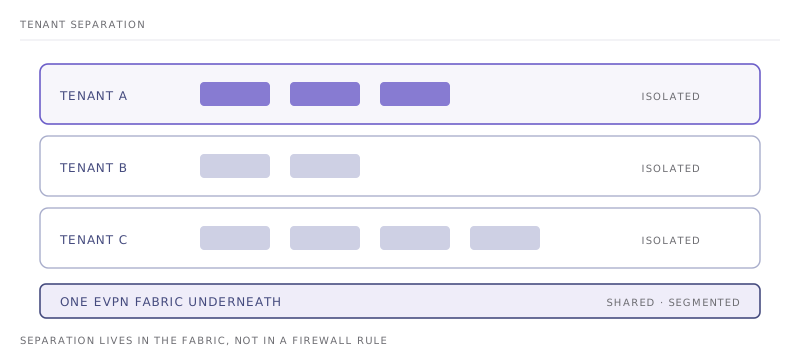
Dedicated hosts, isolated tenant networks on the EVPN fabric, or a specific hypervisor version. Talk to us - this is what we do.


What holds either way
- Flat monthly pricing. Sized to the VMs you run rather than metered by the hour. Bandwidth is billed north/south, so there is no per-GB transfer bill to absorb or explain and no reserved-instance math.
- One invoice, one vendor. Compute, storage, network, backup, and support roll up to a single bill from a company that has been in the Richmond area since 1995.
- Backup is part of the platform, not a separate product. It is on by default and billed per GB of backup data, landing in a second facility on a separate power grid and fiber path that you do not have to fund or design.
- Month-to-month, no minimums. Start with one VM or one client. The estate stays on standard Proxmox VE and standard virtual disks, so it can move again.
- Engineers, not a queue. The people who answer are the ones who run the fabric, the storage, and the hypervisors.
How onboarding works
- Scope the workload. Tell us what runs today - VM sizes, storage, how many sites or clients, and what has to stay where it is.
- Get a quote. We come back with a flat-rate proposal, typically within a day.
- Migration assist. We help plan the cutover: replication, DNS, licensing, and the notice your users or your clients need.
- Go live. A direct line to the engineering team from day one.
We will tell you if this is the wrong shape.
Under about ten VMs
A handful of VMs can often stay on one well-specified on-prem host with a tested offsite backup behind it. That is the smaller sale and frequently the right one; the on-prem catalog covers how we manage that hardware.
Cloud-native and global
If the application is built on managed data services, serverless components, or needs an edge presence on three continents, a hyperscaler fits better. What we have instead is data that stays in the country and engineers in your time zone.
Above 50 to 100 VMs
Fixed costs start spreading across enough workloads that owning can win, especially with steady load and staff and space already in place. We will say so, and we run that side too: managed Proxmox on hardware you own, and hybrid arrangements where part of the estate stays on-premise.