DMV-based. Carrier-neutral. Engineered to stay up.
HVENS operates two carrier-neutral PoPs in the DMV region - one in central Virginia, one on Maryland's Eastern Shore - on infrastructure Richweb has run for over a decade.
Two facilities. Different power grids, different weather systems, one operations team.
Geographic separation between our two PoPs spans the Chesapeake: one in central Virginia, one on Maryland's Eastern Shore - different utility providers, different flood plains, different upstream fiber.
- 01 Pixel Factory Ashland, Virginia Production cloud Carrier-neutral, IX on site 37.76° N / 77.48° W
- 02 Choptank Fiber Denton, Maryland DR and backup target Separate power grid and fiber path 38.88° N / 75.83° W
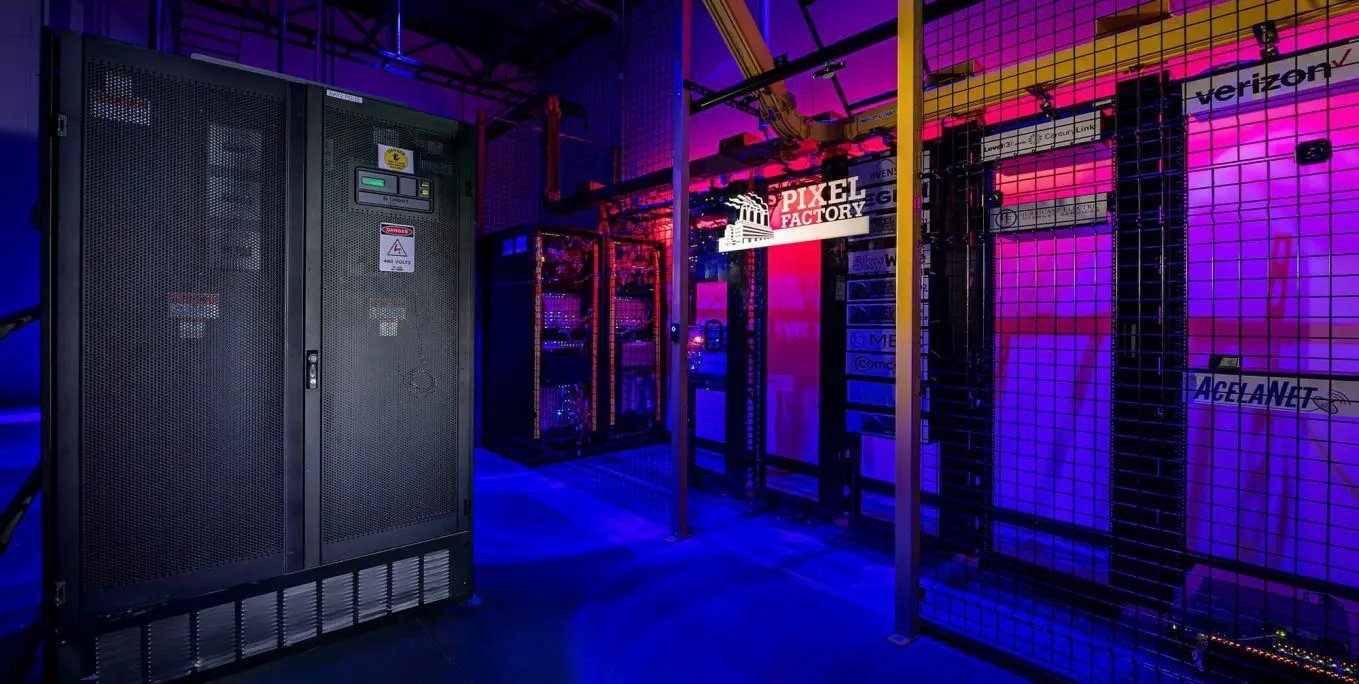
Pixel Factory · Ashland, VA
Our home facility is a carrier-neutral data center in Ashland, Virginia, roughly 15 miles north of Richmond. It's close enough to the Mid-Atlantic fiber corridors to peer with nearly anyone, and far enough from Ashburn to sidestep the Northern Virginia congestion premium. Pixel Factory's deep peering connections - anchored by DE-CIX on-site - keep traffic to major content networks and CDNs on short paths.
- HVENS Cloud production workloads
- DE-CIX Internet Exchange on-site
- Deep peering - Netflix, Google, Akamai, and broader exchange participants
- Redundant power · UPS · generator
- N+1 cooling · 24/7 physical access control

Choptank Fiber · Denton, MD
Our Denton PoP is in Denton, Maryland - roughly 150 miles east of Ashland, on the other side of the Chesapeake Bay. We partner with Choptank Fiber for the facility and upstream connectivity. Choptank peers directly with Pixel Factory, keeping inter-PoP traffic off the public internet.
Beyond its role in geographic redundancy, Denton is a production PoP for customers in Northern Virginia, Maryland, and Delaware - closer proximity, same platform, same engineering team.
- Production workloads for NoVA, Maryland, and Delaware customers
- Offsite replication and PBS backup destination
- Direct peering with Pixel Factory (Ashland PoP)
- Geographically diverse upstream transit via Choptank
- Physically separate power grid (Delmarva) & fiber path
Network
HVENS runs on a cloud network Richweb redesigned from the ground up in 2023.
DE-CIX peering
Co-located with a DE-CIX Internet Exchange point for direct peering with content providers and regional networks.
CDN co-location
On-site peering with Netflix, Google, and Akamai - your client's VM traffic reaches major destinations without taking a long path.
Redundant transit
Multiple upstream carriers with BGP failover. No single provider can take us offline.
50 Mbps to 100 Gbps
Capacity scales with the workload. Whether you need one VM or a private cluster, the path out is not the bottleneck.
IPv4 & IPv6
Full dual-stack provisioning included. IP space is managed in-house - no waiting on a hyperscaler ticket to get public addressing.
EVPN fabric
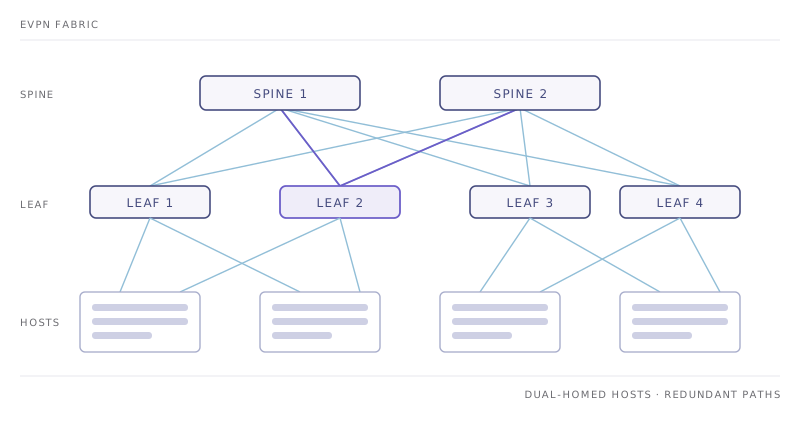
We run an EVPN fabric so customer networks stay cleanly segmented at layer 2 and layer 3 without the overhead of classic VLAN sprawl. Each tenant gets isolated, efficient connectivity that scales with the fabric instead of fighting it.
What the cloud actually looks like.
Every HVENS rack is built the same way: Juniper networking in pairs, Dell compute, storage on its own dedicated fabric, and a management plane that reaches every device even when the production network cannot. This is one of them, top to bottom. Pick any unit to see what it does and why there are two of it.
Two of nearly everything.
Network, compute, storage, and the out-of-band plane that lets us fix the first three remotely. Pick any unit in the elevation.
- Fabric
- EVPN-VXLAN
- Host links
- 25G + 100G
- Storage
- NVMe and capacity tiers
- Hypervisor
- Proxmox VE
- Power
- A/B, metered
- 01Nothing important is singularTwo edge routers, two spines, two storage switches, two power feeds, two links from every host. Anything a VM depends on is in the rack twice, so maintenance is a scheduling question.
- 02Storage has its own fabricTenant traffic and storage traffic run on separate switches at 100G. A rebuild after a failed drive competes with nothing your users are doing.
- 03There is a second way inAn out-of-band switch and a serial console reach every device on a path that does not depend on the production network being healthy. That is how a bad change gets undone at 3 a.m. without a two-hour drive.
Representative of the platform, not a wiring diagram. Rack contents change as capacity is added.

Monitoring & operations
We operate the network we host on. That means one team owns both the VM you're running and the router it's talking to. When something looks off, we see it before you call - and if you do call, you reach the engineer who can actually change something.
- Continuous automated monitoring with on-call engineering
- Proactive capacity and performance alerting
- Live status page for incidents and scheduled maintenance
- Direct engineering escalation for customer issues
Purpose-chosen components across every layer.
Not a default vendor list - each piece is in the stack because it earned its place. These are the platforms and vendors behind HVENS networking, compute, storage, and operations.
Networking
Juniper Networks · OpenGear · OSI Global Optics · OpenBSD
Virtualization & Backup
Proxmox VE · Proxmox Backup Server · Veeam
Storage
Blockbridge · ZFS · Ceph
Infrastructure & Operations
Multiportal · Nautobot · Eaton · LibreNMS
Want to see a demo?
We'll walk you through the portal, the backup and DR workflow, and whatever part of the stack you're evaluating - live, over a call.